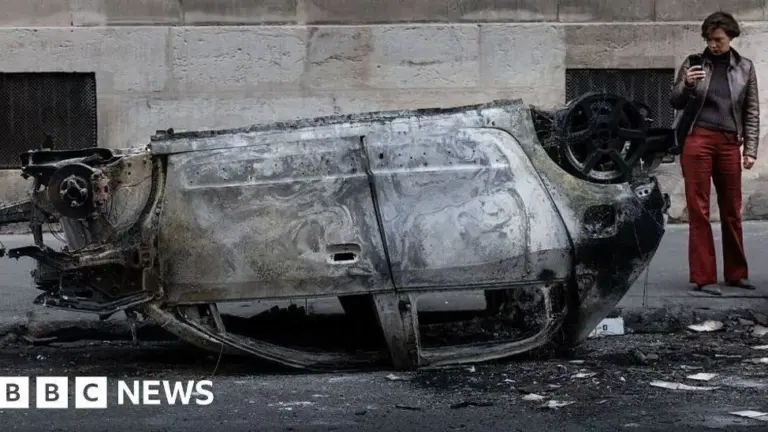
Standing amidst the wreckage of a Parisian street, where shattered glass litters the pavement and red graffiti stains the walls, residents like Elisabeth find themselves grappling with a version of their country they do not recognize. For many locals, the scenes from Saturday’s riots felt less like a political statement and more like a sudden descent into chaos. While some observers fear this represents a slide toward civil war, others insist the violence is an aberration that does not reflect the true face of France. Yet as the smoke clears, the nation remains deeply fractured over who actually orchestrated the mayhem and what it reveals about the current state of society.
Government officials have moved quickly to point fingers at organized radicals. Prime Minister Sebastian Lecornu and Interior Minister Laurent Nunez have both implicated hard-left and anarchist groups, suggesting that student demonstrations were weaponized by political actors to create instability. Intelligence reports highlight the presence of encircled letter A symbols on damaged buildings and videos showing masked individuals attacking police vans with hammers. There are even allegations that far-left movements viewed this unrest as a strategic tool to build momentum ahead of the next presidential election, treating street violence as a form of electoral campaigning.
However, this narrative is fiercely contested by those on the ground and by opposition leaders. Jean-Luc Mélenchon has vehemently denied any role in directing the violence, instead accusing the centrist government of incompetence or perhaps even intentionally allowing things to spiral out of control to frame themselves as protectors of order. Student organizers argue that their anger is organic and born from genuine frustrations over education and inequality rather than political manipulation. They describe it as insulting to suggest that youth desperation can be reduced to a puppet show managed by politicians in distant offices.
Adding another layer to the crisis is the apparent opportunism seen during the looting of thousands of businesses across the country. While some attacks appeared tactical, much of the theft seemed random, with teenagers filming their hauls for social media or attempting to sell designer sneakers online almost immediately. This phenomenon has led some officials to warn against a TikTokisation of violence, where viral clips encourage impressionable youths to participate in riots for clout or profit. As investigators sift through CCTV footage and digital trails, France finds itself caught in a cycle of finger-pointing that mirrors its own volatile political climate just months before a critical national election.